Our most recent collaborative publication with following partners from the SPP 2306:
Marcus Conrad, Maria Fedorova, Hamed Alborzinia and Jose Pedro Friedmann Angeli
Our most recent collaborative publication with following partners from the SPP 2306:
Marcus Conrad, Maria Fedorova, Hamed Alborzinia and Jose Pedro Friedmann Angeli
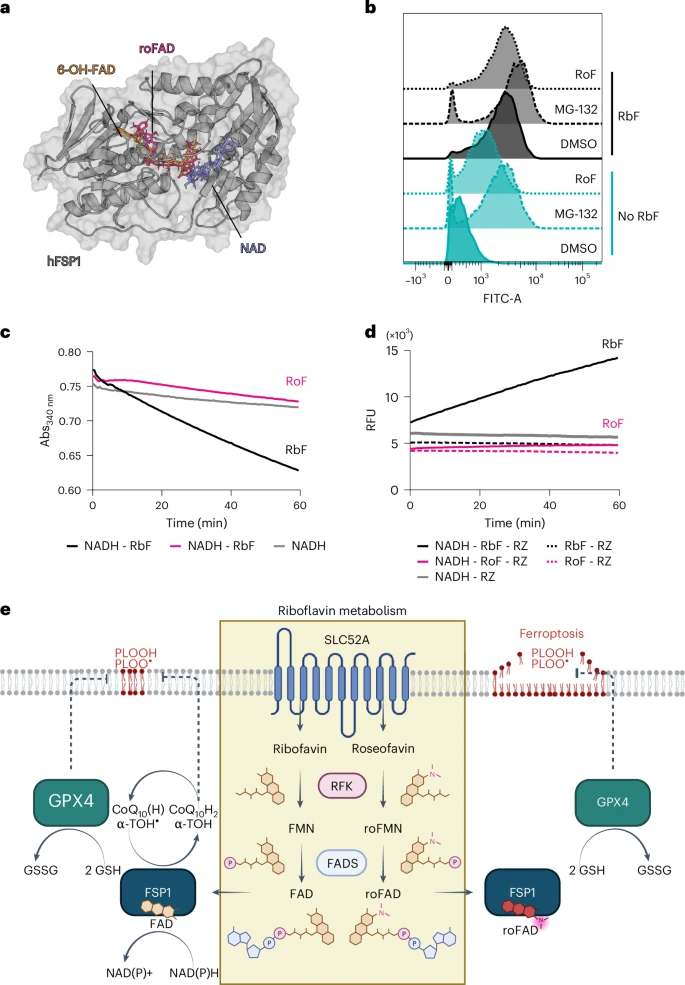
Riboflavin metabolism shapes FSP1-driven ferroptosis resistance.
Skafar V, de Souza I, Ghosh B, Ferreira Dos Santos A, Porto Freitas F, Chen Z, Sun S, Donate Castillo M, Nepachalovich P, Seufert L, Bothe S, Tschuck J, Mathur A, Nunes-Alves A, Buhr J, Aponte-Santamaría C, Schmitz W, Mack M, Eilers M, Bargou R, Chaufan M, Kaur M, Palma M, Ubellacker JM, Elling U, Augustin HG, Hadian K, Meierjohann S, Proneth B, Conrad M, Fedorova M, Alborzinia H, Friedmann Angeli JP.
Nat Cell Biol. 2026 Mar 13. doi: 10.1038/s41556-025-01856-x. Online ahead of print.PMID: 41826699
Membrane protection against oxidative insults is achieved by the concerted action of glutathione peroxidase 4 (GPX4) and endogenous lipophilic antioxidants such as ubiquinone and vitamin E. More recently, ferroptosis suppressor protein 1 (FSP1) was identified as a critical ferroptosis inhibitor, acting via the regeneration of membrane-embedded antioxidants. Yet, regulators of FSP1 are largely uncharacterized, and their identification is essential for understanding the mechanisms buffering phospholipid peroxidation and ferroptosis. Here we report a focused CRISPR-Cas9 screen to uncover factors influencing FSP1 function, identifying riboflavin (vitamin B2) as a modulator of ferroptosis sensitivity. We demonstrate that riboflavin supports FSP1 stability and the recycling of lipid-soluble antioxidants, thereby mitigating phospholipid peroxidation. Furthermore, we show that the riboflavin antimetabolite roseoflavin markedly impairs FSP1 function and sensitizes cancer cells to ferroptosis. Our findings provide a rational strategy to modulate the FSP1-antioxidant recycling pathway and underscore the therapeutic potential of targeting riboflavin metabolism, with implications for understanding the interaction of nutrients, as well as their contributions to a cell’s antioxidant capacity.

© Copyright – SPP 2306 | Privacy Policy | Webdesign: Science Crunchers
 Annual Meeting SPP 2306“ Ferroptosis: from Molecular Basics to Clinical A...