Our most recent collaborative publication with following partners from the SPP 2306:
Silvia von Karstedt, Julia Esser-von-Bieren, Marcus Conrad and Jan P. Böttcher

Our most recent collaborative publication with following partners from the SPP 2306:
Silvia von Karstedt, Julia Esser-von-Bieren, Marcus Conrad and Jan P. Böttcher
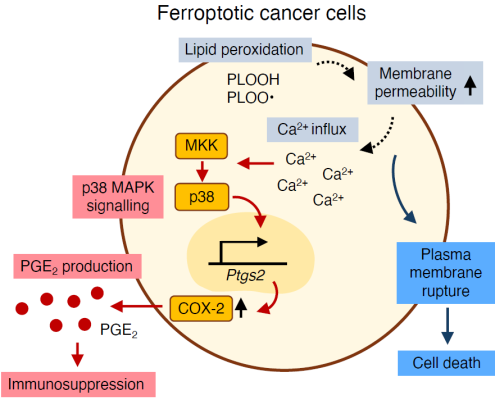
Scheme illustrating the molecular mechanism underlying production of the immunosuppressive lipid PGE2 in ferroptotic cancer cells uncovered by Ramsauer et al., Nature, 2026.
Ramsauer L, Pedde AM, Hirschberger A, Parra Reyes M, Nuschele N, Bayerl F, Lacher S, Donakonda S, Schmid K, Spitzlberger B, Chakma D, Anton M, Bebber CM, Wiedemann GM, Nakamura T, Ebert G, Dixon SJ, Knolle PA, von Karstedt S, Snaidero N, Esser-von Bieren J, Conrad M, and Boettcher JP.
Nature (2026). https://doi.org/10.1038/s41586-026-11333-6
Ferroptosis, a form of cell death induced by overwhelming membrane lipid peroxidation, is a vulnerability of many cancers, including cancers resistant to current molecular and immune-based therapies1,2,3,4,5,6,7. Triggering of ferroptosis therefore provides an opportunity to achieve elimination of difficult-to-treat cancers1,2,3,4,8,9. Studies in mouse cancer models have demonstrated that anticancer immunity, mediated by dendritic cells (DCs) and CD8+ T cells, is essential for effective tumour eradication by ferroptosis-inducing strategies10,11,12,13. However, ferroptotic cells limit this response8,9,10,14, resulting in immune escape and tumour growth through mechanisms that remain unclear. Here we demonstrate that ferroptotic cancer cells activate a molecular program resulting in aberrant production of prostaglandin E2 (PGE2), which limits the stimulation of anticancer CD8+ T cell responses by type 1 conventional DCs (cDC1s), thereby promoting immune escape. In ferroptotic cancer cells, lipid peroxidation-mediated membrane permeabilization enables Ca2+ influx, which activates p38 MAPK signalling and thereby drives PGE2 production. This signalling axis is uncoupled from cancer cell death and can be targeted to selectively interfere with immune-inhibitory PGE2 production while preserving ferroptotic cancer cell elimination. In the context of cancer cell ferroptosis, ablation of PGE2 production or disrupting PGE2 signalling restores cDC1-mediated anticancer CD8+ T cell responses and leads to effective tumour elimination. Our findings identify a key mechanism that limits antitumour immunity and prevents tumour elimination upon ferroptosis induction in cancer cells, which could be exploited for cancer therapy.

© Copyright – SPP 2306 | Privacy Policy | Webdesign: Science Crunchers
 Bild: IHK Feldkirchen Westerham