Our most recent collaborative publication with following partners from the SPP 2306:
Marcus Conrad and Tobias Dick
Our most recent collaborative publication with following partners from the SPP 2306:
Marcus Conrad and Tobias Dick
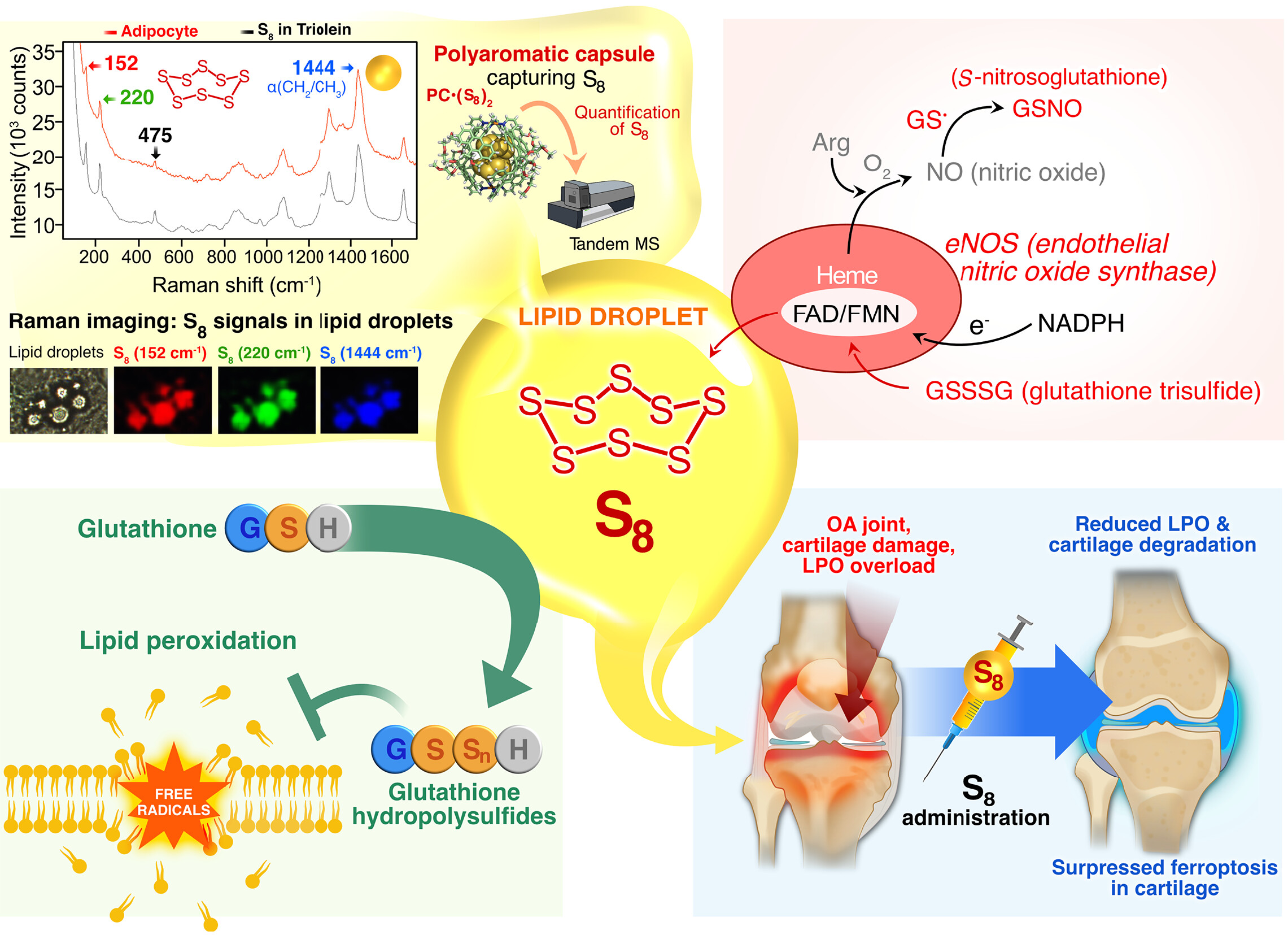
Mammals produce cyclo–octasulfur to suppress lipid peroxidation and ferroptosis.
Barayeu U, Ogata S, Takata T, Jung M, Matsunaga T, Morita M, Ida T, Lange M, Unno Y, Boushehri S, Greicius P, Nishimura A, Catti L, Pan Y, Zhang T, Shimizu T, Ushioda R, Nakabayashi T, Asamitsu S, Fusegawa K, Suzuki T, Ishida T, Tanda N, Watanabe Y, Tsuchiya Y, Yamaguchi R, Noguchi S, Mishima E, Yano F, Arisawa M, Stuehr DJ, Xia N, Li H, Moosmann B, Gräter F, Aponte-Santamaría C, Olzmann JA, Conrad M, van der Vliet A, Dick TP, Motohashi H, Yoshizawa M, Akaike T.
Science. 2026 Sep 24;393(6818):eaec5473. doi: 10.1126/science.aec5473. Epub 2026 Sep 24.PMID: 42784683
Elemental sulfur is an evolutionarily ancient metabolite, yet its generation, storage, and function in animals have remained unclear. We show that mammals harbor elemental sulfur in the form of its most stable allotrope, cyclo-octasulfur (S8). We found that S8 accumulates to millimolar concentrations in mitochondrial membranes and in lipid droplets in both mouse and human cells. We further identified lipid droplet-associated nitric oxide synthase as a source of S8 biosynthesis and found that S8 accumulation in lipid droplets limits lipid peroxidation and suppresses ferroptosis. Accordingly, intra-articular injection of solubilized S8 reduces lipid peroxidation in a mouse model of osteoarthritis. Together, these findings reveal an endogenous pool of S8 in mammals that may protect cells from oxidative membrane damage by modulating cellular sensitivity to ferroptosis.
© Copyright – SPP 2306 | Privacy Policy | Webdesign: Science Crunchers

 Bild: IHK Feldkirchen Westerham2nd International SPP2306 Meeting